Water Tank Cleaning in Dubai
Water tank cleaning removes sediment, algae and bacterial buildup from villa and rooftop tanks, following the intervals Dubai Municipality sets for residential water storage.
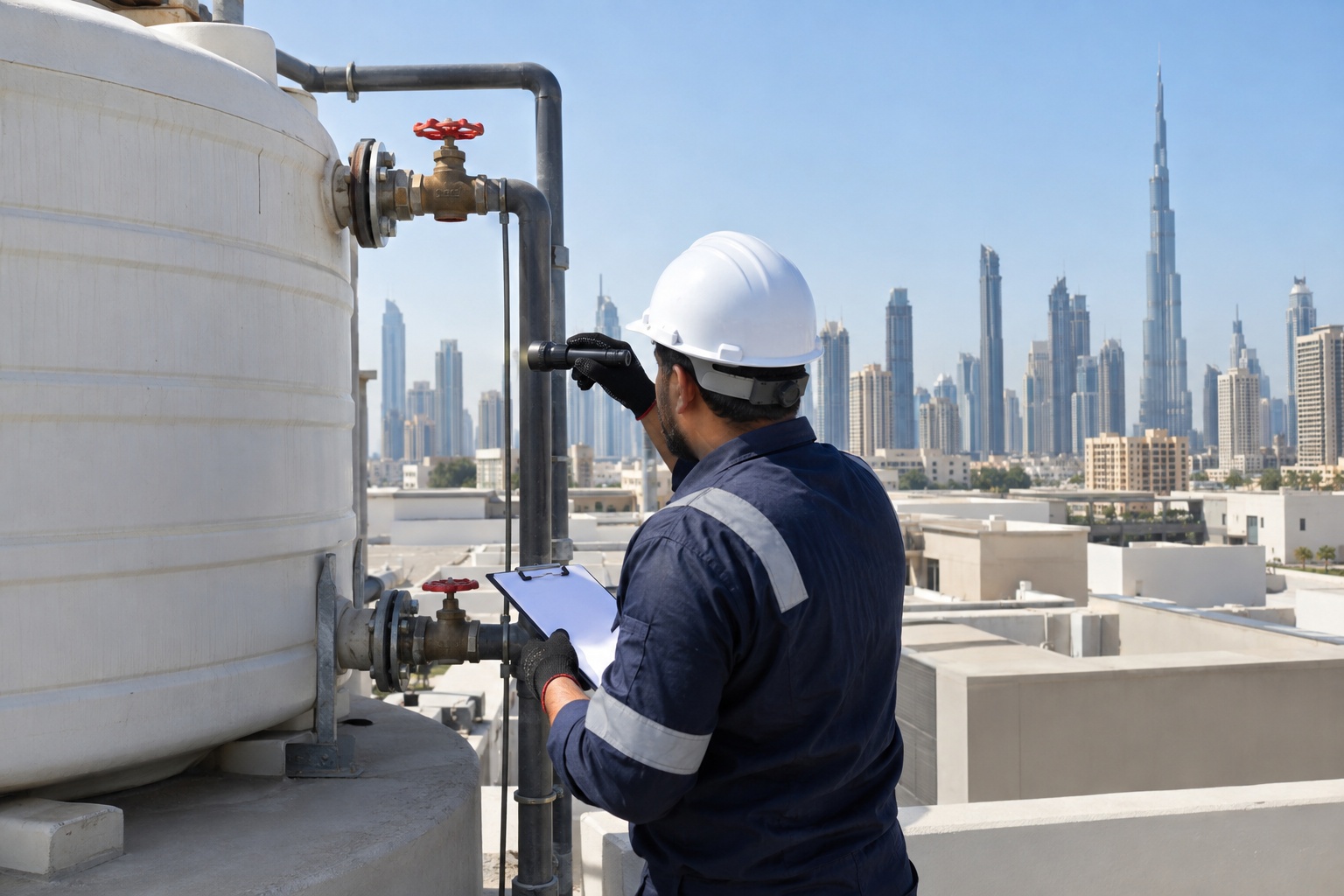
Water sitting in a tank for months picks up sediment, algae and bacteria long before anything looks visibly wrong from the tap. A cloudy or foul-smelling tap, a metallic or musty taste, or visible discoloration in water that has been standing overnight are the usual first signs that a tank needs attention. By the time sediment is heavy enough to clog a shower head or a washing machine filter, the tank itself is typically well overdue for a clean.
Dubai Municipality requires residential water tanks to be professionally cleaned at regular intervals, and sets specific guidelines for how the job should be carried out — covering how the tank is emptied, scrubbed, disinfected and refilled before it goes back into use. Most households do not track that interval closely, which is why the majority of call-outs happen only after a smell or a discoloured glass of water prompts someone to look into it. A tank cleaned on a proper schedule rarely gets to that point.
Why tanks need regular cleaning at all
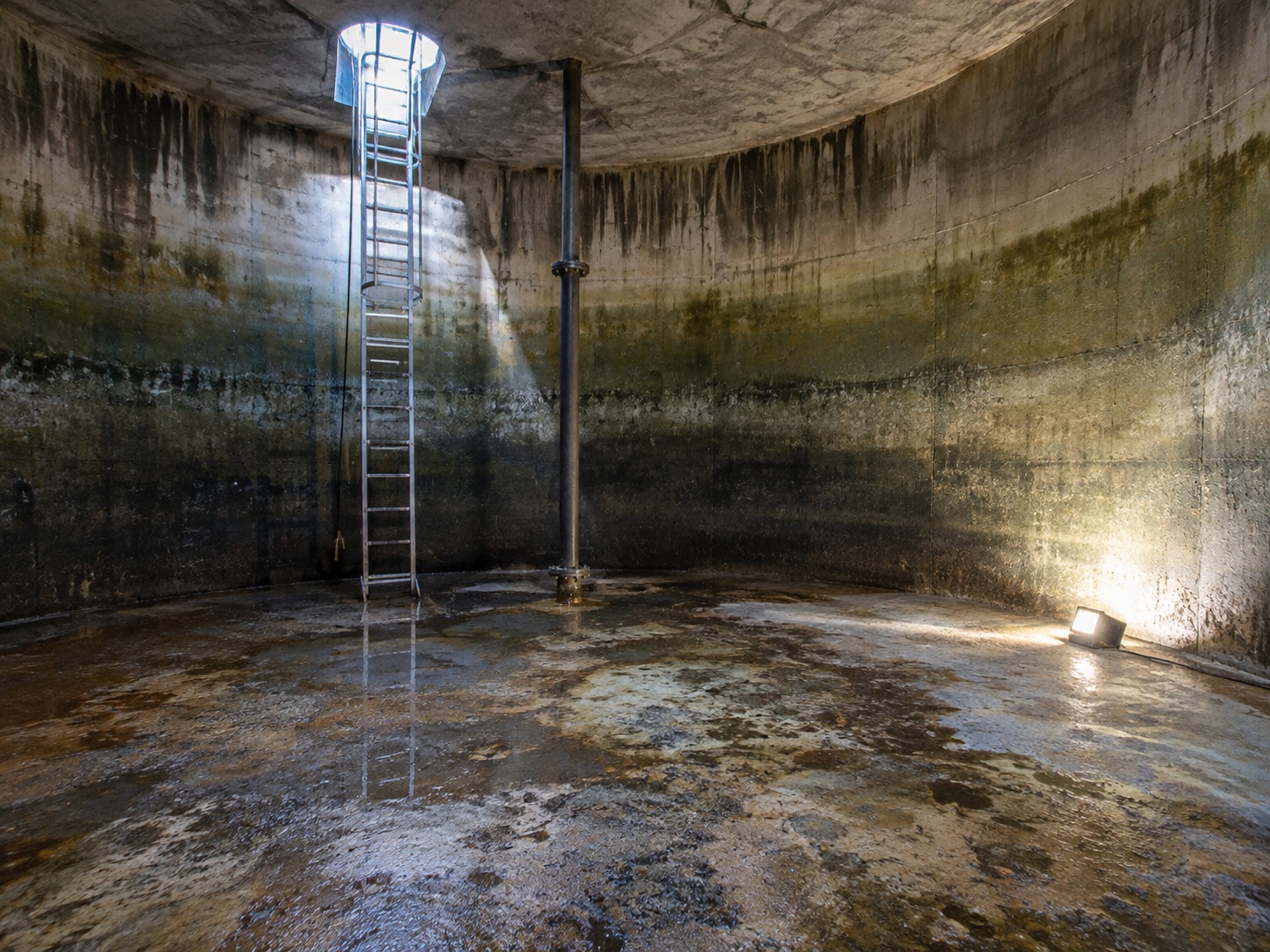
Even a tank filled with perfectly clean mains or tanker water does not stay that way, because a storage tank is a still body of water and stillness is what allows contamination to build. Every fill carries a small amount of fine mineral particles and silt, and because the water in the tank barely moves, those particles settle to the floor. Over months the layer thickens into a soft sediment bed that no amount of fresh water flowing in will disturb. That bed is where the trouble starts.
Sediment gives bacteria a surface to attach to and nutrients to feed on. Once a colony establishes itself it produces a biofilm, a slimy protective layer that spreads across the tank floor and up the walls, and which ordinary flushing does not remove. Warm ambient temperatures accelerate the process, which is why tanks in Dubai reach this stage faster than tanks in cooler climates. If the tank cover, vent or any inspection hatch lets in even a small amount of light, algae join the picture and add green staining, a strong earthy smell and yet more organic material for bacteria to feed on.
The mains supply into the tank carries a residual level of disinfectant, but that residual decays over time and is consumed by organic matter in the tank. In a clean tank it lasts long enough to keep the water safe. In a tank with a sediment bed and biofilm it is used up quickly, leaving the stored water unprotected. This is the mechanism behind the municipality’s insistence on regular cleaning: the water is fine going in, and it is the tank itself that degrades it.
What happens during a tank cleaning visit, step by step
A proper clean is a sequence of stages, each of which depends on the one before it having been done thoroughly.
-
Isolating and draining the tank. The inlet is shut off so no fresh water enters mid-job, and the tank is pumped or drained down through the outlet or a submersible pump. Draining is timed for when the household or building can be without water for a few hours, and where a property has more than one tank they are usually handled one at a time so supply is not lost entirely.
-
Removing sediment and sludge. With the tank empty, the accumulated sediment on the floor is removed by wet-vacuum or by hand. This is the material that regular flushing never reaches, and it is often the moment the customer first sees how much had built up.
-
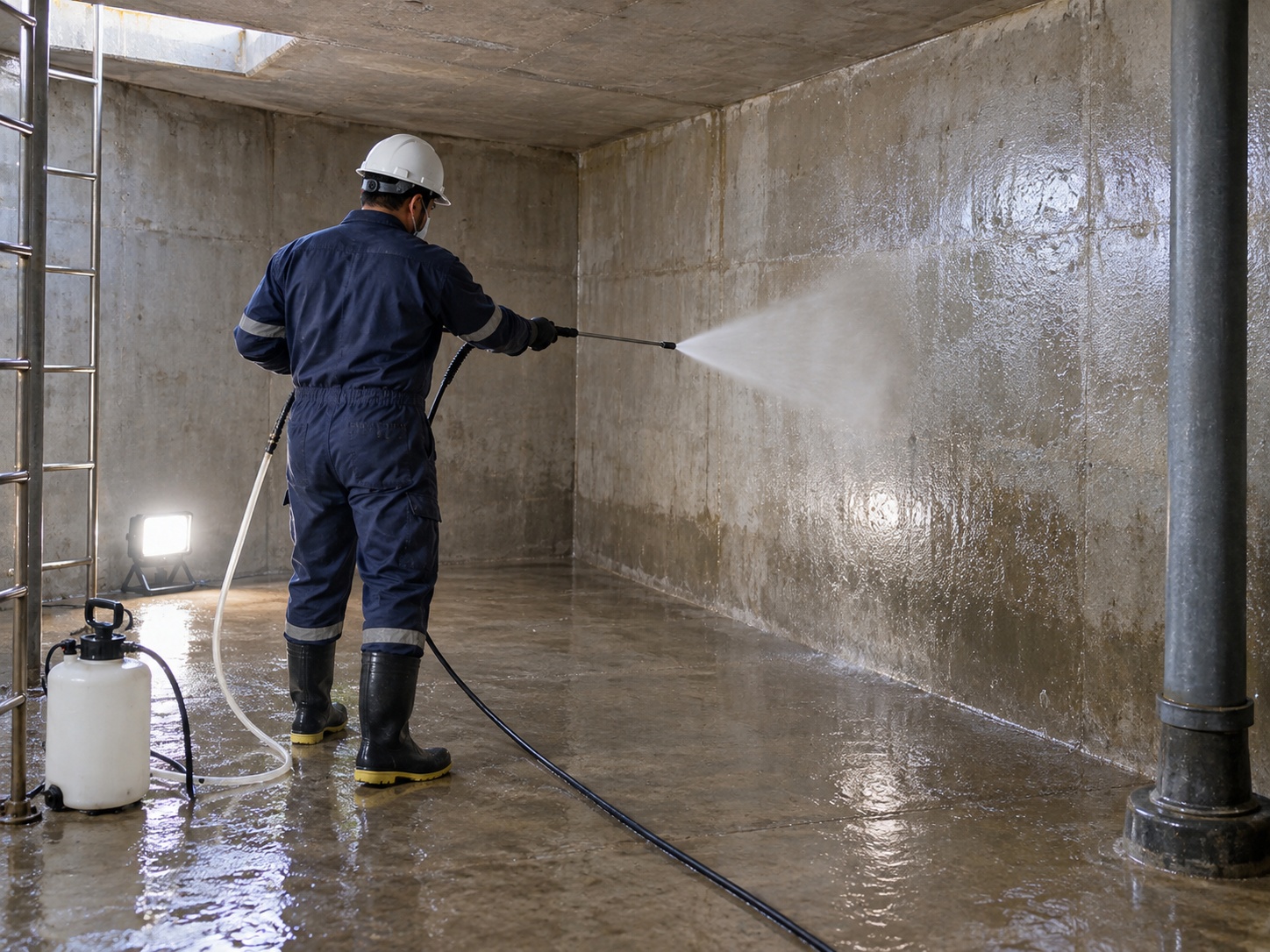
Scrubbing walls, floor and fittings. Every interior surface is physically scrubbed to break the biofilm and lift algae staining. Corners, the floor-to-wall joint, the area around the inlet and outlet, and the underside of the cover are given particular attention because biofilm establishes itself first in the places water moves least. A pressure washer is used on concrete tanks where the surface tolerates it.
-
Disinfection. A food-grade disinfectant is applied across all interior surfaces and left for the contact time it needs to work. This is the stage that deals with bacteria the scrubbing has loosened but not killed, and it is the part of the process the Dubai Municipality guideline is most specific about.
-
Thorough rinse. The disinfectant is rinsed out completely and the rinse water pumped away. Skipping or rushing this stage is what leaves a chemical smell at the tap afterwards, so it is done until the rinse runs clear.
-
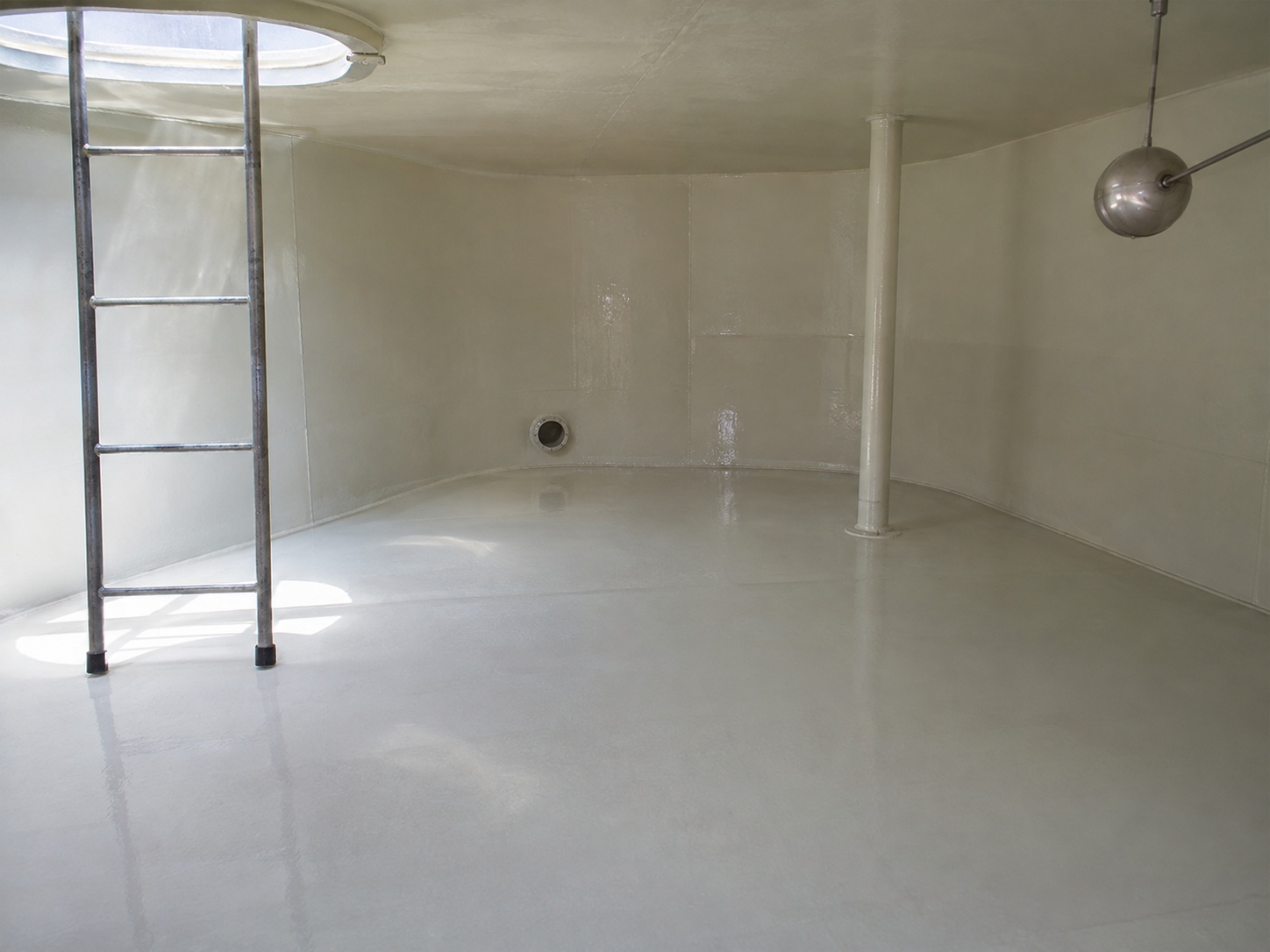
Refilling and final check. The inlet is reopened and the tank refilled. The refilled water is visually checked for clarity, the first draw is run through the pipework to flush the lines, and the cover, vent screen, float valve and seals are inspected and reseated. A poorly fitting cover or a torn vent mesh is one of the most common reasons a tank gets contaminated again soon after cleaning, so this closing check matters as much as the scrubbing.
Villa underground tanks vs. building rooftop tanks
The two common tank setups in Dubai call for genuinely different working methods, even though the cleaning stages are the same.
Villa tanks are usually a single concrete or GRP tank buried in the garden or set into a ground-level chamber, feeding the whole property through a pump. Access is through a manhole or hatch, which makes the job a confined-space one: ventilation, lighting and a second person at the surface are part of the setup. Villa tanks are typically sized for one household, so draining and refilling is relatively quick, but because they sit underground they are also the ones most likely to have gone years without inspection. Sediment beds in villa tanks tend to be deep, and a cracked or ill-fitting manhole cover can let in garden soil and insects on top of the usual buildup.
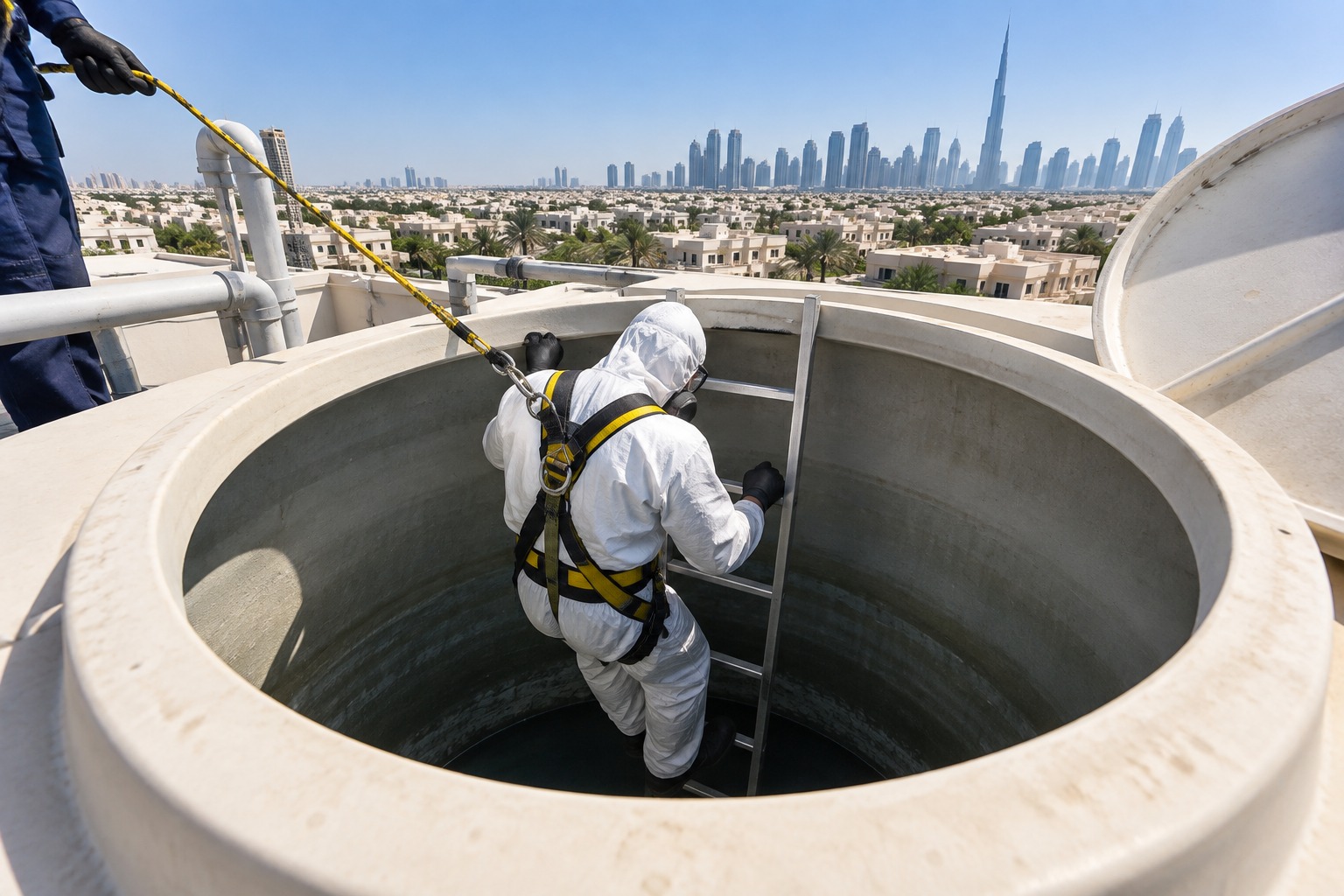
Rooftop building tanks serve apartment blocks and commercial buildings and sit at height, often as a bank of two or more tanks fed by a pump room below. Access is via the roof with harness and edge-protection, and working around the tank set means safety planning is a bigger part of the visit than on a villa. Capacity is much larger, refills take longer, and because dozens of households depend on the supply, timing has to be agreed with building management and communicated to residents in advance. Rooftop tanks are also exposed to direct sun and daytime heat that underground tanks never see. The water warms, any light leak through the cover or vent feeds algae growth, and disinfectant residual decays faster, all of which push rooftop tanks toward more frequent cleaning than a shaded underground tank of the same age.
We work both setups and plan the drain-and-refill timing around what each property actually needs, rather than applying one schedule to every job.
The Dubai Municipality guideline, explained
Dubai Municipality publishes guidelines for the cleaning and disinfection of water tanks in residential and commercial buildings, and the same question comes up from almost every property owner who searches for “approved”, “guidelines” or “regulations” around tank cleaning: what does the rule actually say?
In general terms, the guideline covers three things. First, frequency: tanks are to be cleaned and disinfected at regular intervals as set by the municipality, with the expectation that building owners and management companies keep to that schedule rather than waiting for complaints. Second, method: the guideline describes the sequence of draining, physical cleaning, disinfection and rinsing outlined above, and sets expectations for the disinfectant used and the standard the water should meet before the tank returns to service. Third, records: property owners and building management are expected to keep a record of when tanks were cleaned and by whom, which is the document most often requested during an inspection or when a building changes management.
The guideline is a framework the municipality sets and enforces, and its purpose is to make sure the water reaching taps is as safe as the water that left the mains. Property owners who want the exact current wording should refer to Dubai Municipality’s published materials, and the cleaning we carry out follows the sequence and disinfection stages that the guideline describes.
Signs your tank needs cleaning now
Not every warning sign is dramatic, and most build up gradually enough that a household stops noticing them.
- Odour from the tap. A musty, earthy or swampy smell points to algae or biofilm; a sharp chlorine-like smell that appears after months of nothing can mean disinfectant is reacting with organic matter in the tank.
- Visible discoloration. Water that looks yellow, brown or cloudy in a glass, particularly first thing in the morning after standing overnight in the pipework, is carrying suspended sediment or rust from the tank.
- Sediment or particles in the water. Grit at the bottom of a kettle, dark flecks in a glass or a filter cartridge that clogs far sooner than it should are all sediment leaving the tank.
- Reduced water pressure. Sediment and biofilm break away and collect in tap aerators, shower heads, float valves and appliance inlet filters, choking the flow long before the pump itself has any fault.
- A long gap since the last clean. If no one can say when the tank was last cleaned, or a property has just changed hands or management, the tank is almost certainly past the interval the municipality sets.
Any one of these is a reason to book a visit. Two or more together usually mean the tank is well overdue and the household has been drinking, cooking and bathing in water stored above a sediment bed for some time.
Frequently asked questions
- How often does Dubai Municipality recommend water tanks be cleaned?
- Dubai Municipality's guideline calls for residential water tanks to be cleaned and disinfected at regular intervals as set by the municipality, with the exact frequency depending on the type of property and how the tank is used. Rooftop tanks exposed to direct sun and heat, and tanks serving many households, tend to need attention at the shorter end of any range. If you cannot remember when your tank was last cleaned, that alone is usually reason enough to schedule a visit.
- What is the difference between cleaning a villa tank and a rooftop building tank?
- A villa tank is usually a single underground or ground-level concrete chamber reached through a manhole, so the work is mostly about draining safely, working in a confined space and refilling before the household runs dry. A rooftop building tank is reached at height with harness and edge-protection, is often one of several tanks in a set, and serves every apartment below it, so the drain-and-refill has to be coordinated with building management and residents. The cleaning steps themselves are the same; the access, safety planning and scheduling are what change.
- What are the signs my water tank needs cleaning?
- The common signs are a musty, earthy or chlorine-like smell from the tap, water that looks cloudy, yellow or brown after standing overnight, grit or dark particles collecting in a glass or in appliance filters, weaker pressure at shower heads and taps from sediment clogging outlets and aerators, and simply a long gap since the last clean. Any one of these is worth acting on; two or more together usually mean the tank is overdue.
- Is the water safe to use immediately after cleaning?
- After the tank has been scrubbed, disinfected and thoroughly rinsed, it is refilled with fresh mains or tanker water and the first draw is run through the pipework to flush any residual disinfectant. Once the water at the tap runs clear and without a chemical smell, it is ready for normal household use. If a strong chlorine smell lingers at a particular tap, running it for a couple of minutes clears the line.
- Do you clean both underground and rooftop tanks?
- Yes. We clean underground and ground-level villa tanks and rooftop tanks on apartment buildings and commercial properties, including multi-tank rooftop installations. The visit is planned around the access each property has, whether that is a manhole and confined-space setup at ground level or harness and edge-protection work at roof height, and around a drain-and-refill window that suits the residents.
- How long does a typical tank cleaning visit take?
- Most single villa tanks are drained, cleaned, disinfected and refilled within a few hours, with the draining and refilling stages taking up the largest share of that time. Rooftop building tanks vary more, because access, tank size and the number of tanks in the set all affect the schedule, and the refill can run into the evening on larger buildings. We confirm a realistic window when booking so residents know when water will be back on.
Areas we cover for this service
Area pages with building-type notes, local pricing and availability for that community.