AC Duct Cleaning in Dubai
AC duct cleaning clears dust, allergens, and debris from inside your air conditioning ductwork, restoring airflow and improving the air quality throughout your Dubai home.
What AC duct cleaning involves
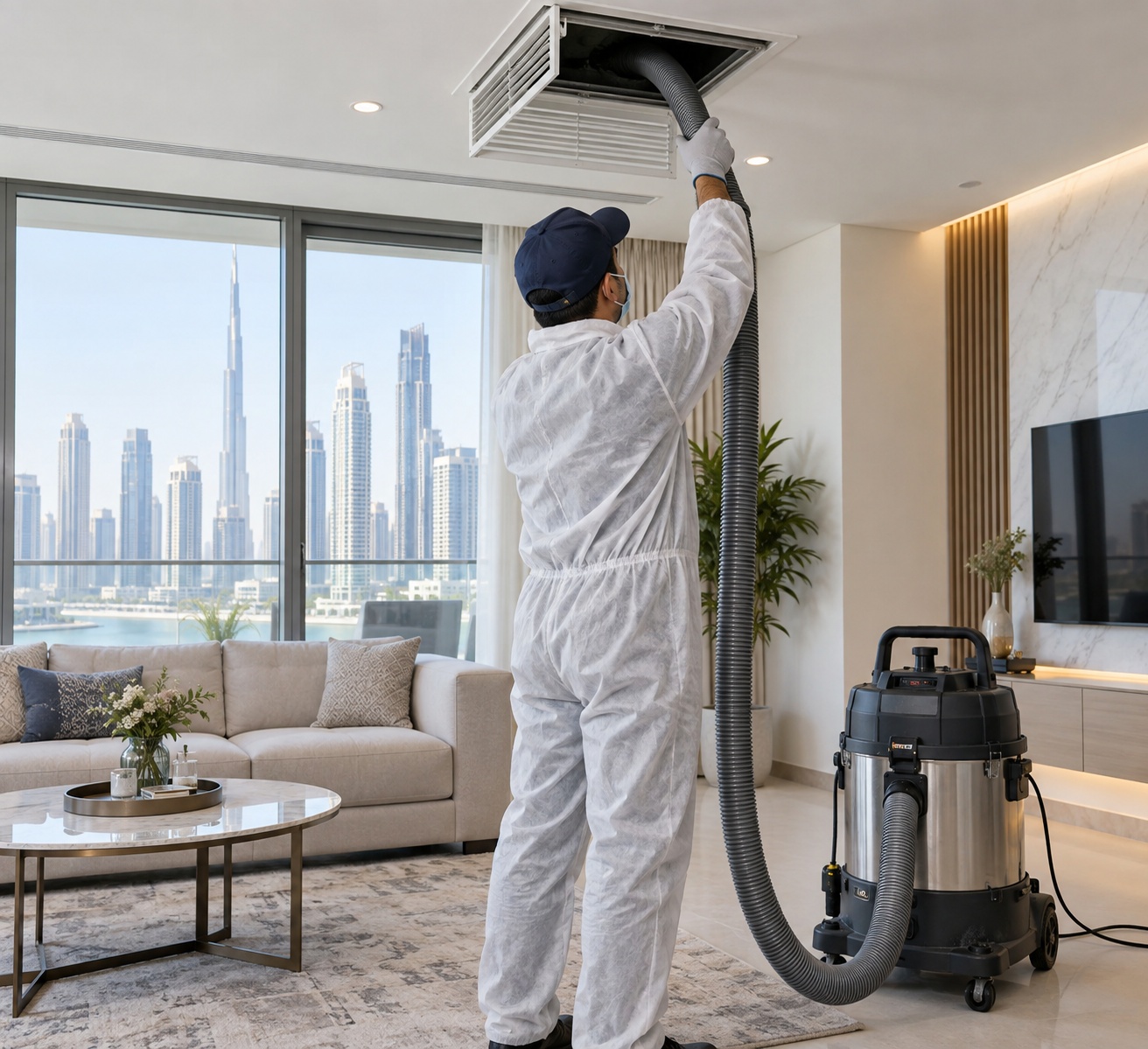
AC duct cleaning is a deeper, more specialised job than routine AC maintenance. Instead of servicing the indoor and outdoor units, a technician accesses the ductwork itself — the network of galvanised metal or flexible insulated channels that carry cooled air from your fan coil unit to every room, and the return path that draws warm room air back to be cooled again. Using a flexible hose attached to a high-powered HEPA-filtered vacuum, along with rotating brushes and compressed-air agitation tools, the technician dislodges and extracts dust, sand, lint, and debris from inside the duct walls, then cleans the supply and return grilles so air can move through the system freely again.
The aim is not just to make the visible grilles look clean. It is to clear the full length of the air pathway, from the unit to the last vent, so that the AC stops recirculating whatever has settled inside it over the years.
What actually happens during a duct cleaning visit
A proper duct clean follows a set sequence. If a provider skips most of these steps and only wipes the grilles, you are paying for a surface clean, not a duct clean.
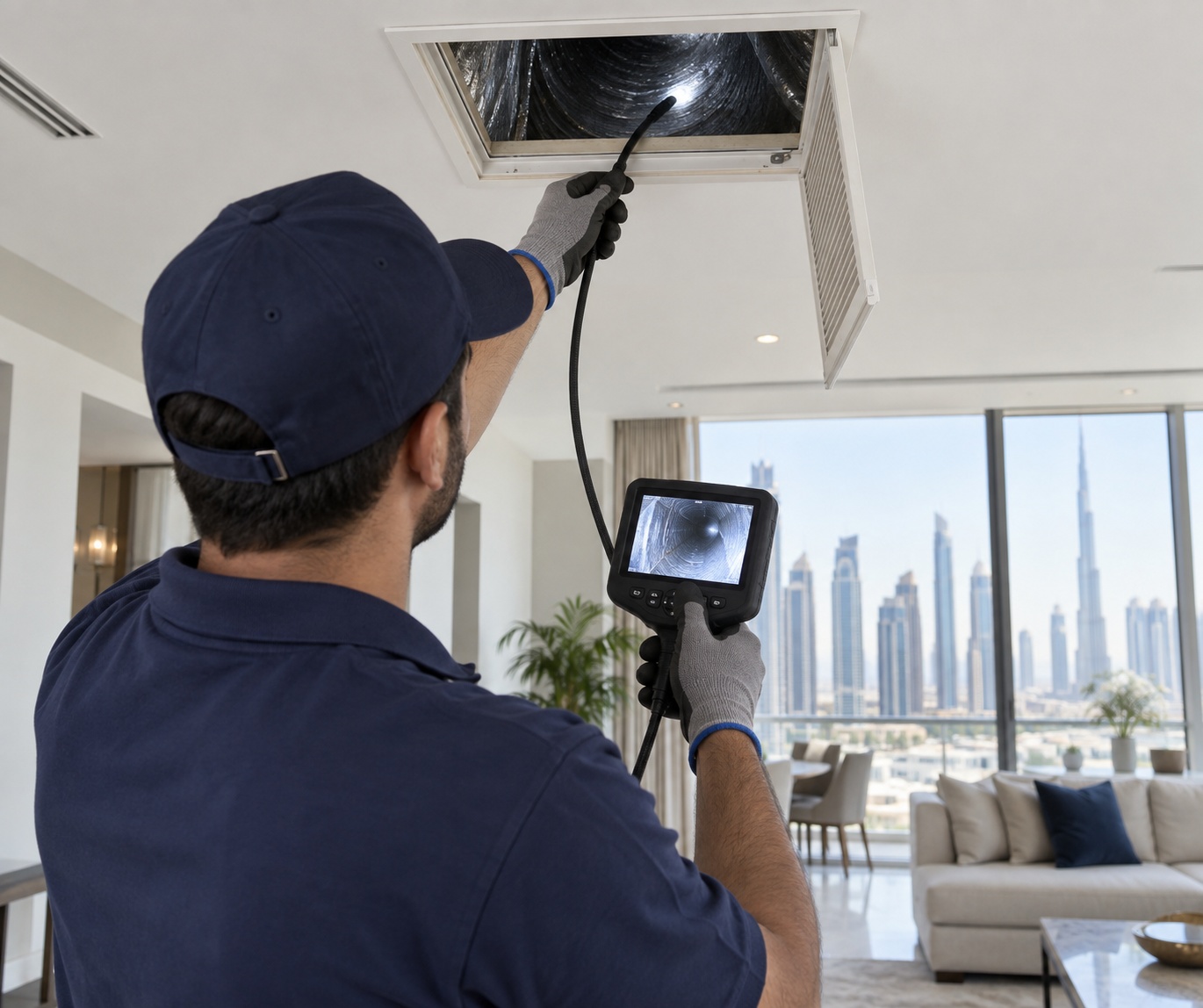
- Inspection of duct access points. The technician locates every supply and return grille, identifies the fan coil unit or air handler, and checks where the duct runs sit above the false ceiling. Where possible, a flexible inspection camera is fed into the duct to see how much buildup is inside and whether there are any loose joints, damaged insulation, or signs of moisture. This tells them how heavy the job is and where the worst accumulation sits.
- Removing and cleaning the grilles. Supply and return grilles are unscrewed or unclipped, washed or vacuumed, and set aside. The openings they leave are the main access points into the ductwork.
- Setting up negative-pressure extraction. A powerful vacuum unit with HEPA filtration is connected to the duct system, usually at the return side or a purpose-cut access point near the unit. Running it puts the entire duct run under negative pressure, so that any dust dislodged further along is pulled towards the vacuum rather than blown back into the room. Other openings are temporarily covered so the suction concentrates where it is needed.
- Brushing and agitating the buildup. With extraction running, the technician works through each branch with rotating brushes on flexible rods, compressed-air whips, or both. This loosens the compacted layer stuck to the duct walls, which is the part a vacuum alone cannot remove. Sand and fine dust that has bonded with humidity into a crust needs mechanical agitation to come off.
- Cleaning the unit-side components. The plenum, the blower housing, and the area around the evaporator coil are vacuumed and wiped, since dust that has collected here is pushed straight down the supply ducts every time the fan starts.
- Sealing access points back up. Any access holes cut into the ductwork are sealed with proper duct panels or foil tape, not left open or covered with ordinary tape. The grilles are refitted and re-secured.
- A final airflow check. The system is switched back on and each vent is checked for airflow and for any dust or smell coming through. Where the technician measured airflow before starting, the before-and-after comparison is the clearest sign the job made a difference.
Depending on the size of the property, the whole visit can take a few hours for an apartment or most of a day for a villa with multiple AC zones.
Why this is genuinely different from AC maintenance
It is easy to assume duct cleaning is just a bigger, more thorough version of an AC service. It is not. The two services touch different parts of the same system.
Routine AC maintenance focuses on the unit itself. The technician cleans or replaces the filter, washes the evaporator and condenser coils, clears the drain line, checks refrigerant pressure and gas levels, and confirms the electrical and mechanical parts are running as they should. This keeps the unit cooling efficiently and prevents breakdowns, and it should be done regularly.
None of that reaches the ductwork. The filter sits at the unit, so it only catches what passes through it at that point. Dust that has already made its way past the filter over years of use, or that has entered the ducts through gaps at joints and around grilles, stays where it settled. A maintenance visit does not put a brush or a vacuum inside the duct run, so a freshly serviced unit can still be pushing perfectly cold air through channels lined with a thick layer of dust and sand.
Duct cleaning goes further upstream, into the ductwork the conditioned air actually travels through before it reaches your rooms. That is why the two services are usually scheduled separately: one keeps the machine healthy, the other keeps the air pathway clean.
Signs your ducts specifically need cleaning
Some problems point to the unit needing a service, while others point squarely at the ducts. If you notice the following, the ductwork is the likely culprit:
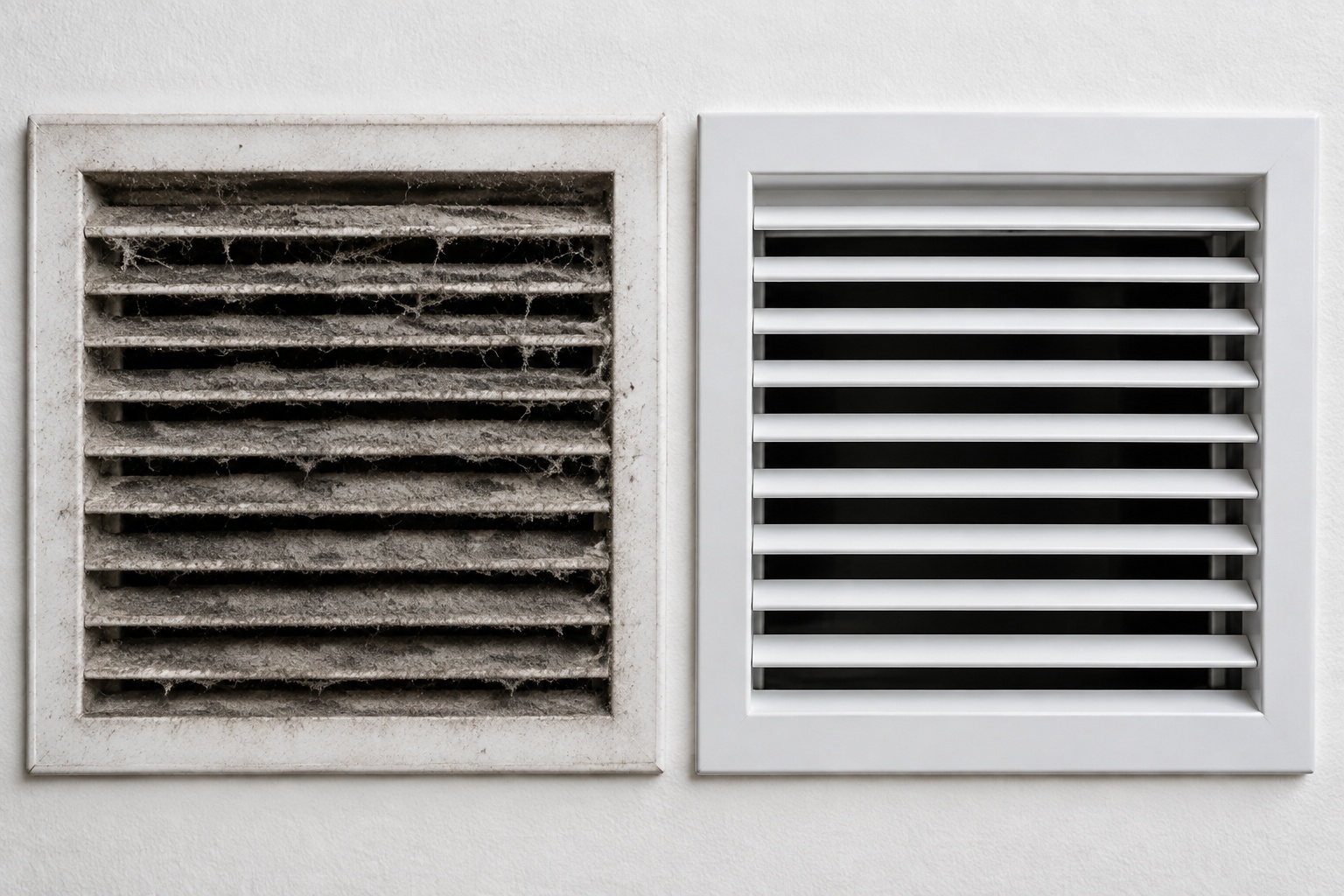
- Visible dust blowing from the vents. Puffs of dust when the AC starts, or streaks of grey around the grille edges and on the ceiling near the vent, mean dust is sitting inside the supply duct and being carried out with the airflow.
- A musty or stale smell when the AC first turns on. Dust inside ducts absorbs humidity, especially in Dubai’s summer, and the combination gives off a distinctive stale odour that is strongest in the first few minutes after the system starts and then fades.
- Allergy symptoms that are worse indoors. Sneezing, congestion, or irritated eyes that flare up at home and ease when you go out suggest something in the indoor air, and ducts that recirculate settled dust are a common cause.
- Dust resettling quickly after you clean. If surfaces are dusty again within a day or two of a thorough clean, the AC is very likely redistributing dust from inside the ductwork rather than the dust coming from outside.
- Weak or uneven airflow from vents that used to blow strongly, particularly if the unit has recently been serviced and the filter is clean, suggesting the duct interior is partially restricted.
By contrast, an AC that is not cooling properly, dripping water, making unusual noises, or short-cycling is usually a unit problem and needs a maintenance visit, not a duct clean.
Dubai’s sand and construction-dust factor
Dubai’s climate makes ductwork buildup a more persistent issue than in most markets, and it helps to understand why rather than just take it on faith.
The region experiences frequent sandstorms and dust events, particularly in the spring and summer months, and the background air carries a high load of very fine sand and mineral particulate even on clear days. On top of that, Dubai has near-continuous construction and roadworks across most residential areas, which adds cement dust and fine construction debris to the mix.
This particulate is small enough to be drawn into HVAC systems in several ways. Outdoor condensing units and rooftop air handlers pull in outside air directly. Fresh-air intakes on chiller-based buildings do the same. Inside the home, dust enters through the return grilles whenever windows or doors have been open, and through small gaps at duct joints and around grille frames. Because the particles are so fine, a standard filter catches only part of what passes through, and the rest travels into the duct run.
Once inside, the sand and dust settle on the duct walls in the same way they settle on a windowsill. The difference is that ductwork is dark, enclosed, and never wiped down. In summer, the cool duct surface and humid air combine to add moisture, which makes the dust stick and compact into a layer rather than staying loose. With air conditioning running almost year-round, the system never gets a long off-season in which it stops circulating air, so the buildup compounds continuously.
The result is that ductwork in a Dubai villa or apartment accumulates in a couple of years what a system in a cooler, cleaner climate might take much longer to gather. That is what makes periodic duct cleaning a genuinely regional consideration rather than a generic upsell.
How often duct cleaning is actually needed
Duct cleaning is not something that needs doing every few months. It is a less frequent job than a routine AC service, and treating it as a quarterly task would be excessive for most homes.
That said, Dubai’s dust load means the sensible interval here is shorter than the guidance you might find written for milder climates. A few factors push a home towards needing it sooner:
- Location and exposure. Homes near active construction sites, on busy roads, or on the edge of open desert take in more particulate than those in established, enclosed communities.
- How the home is used. Windows opened regularly, pets, and a large household all add to what ends up in the return air.
- The age and condition of the ductwork. Older ducts with loose joints or degraded insulation let in more dust than well-sealed newer systems.
- Occupant sensitivity. Households with allergy or asthma sufferers, young children, or elderly residents benefit from keeping the interval on the shorter side.
- Moving into a property. A duct clean before moving in is worth considering if the previous occupants had pets, smoked indoors, or if the home has just been through renovation, since construction dust inside ducts is common in recently refurbished homes.
The most reliable approach is to combine a rough schedule with the warning signs above. If dust is blowing from vents, the start-up smell has returned, or surfaces are dusting over within days of cleaning, the ducts are due regardless of when they were last done. A quick camera inspection during a routine AC service can also confirm whether a full clean is needed yet or can wait.
What to expect from a good provider
A worthwhile duct cleaning service should be able to explain which of the steps above they carry out and show you the equipment they use, including a HEPA-filtered vacuum rather than a household model. Ask whether they inspect the ducts before and after, whether they seal any access points they open, and whether they clean the plenum and blower area at the unit, not just the grilles. Before-and-after photos from the inspection camera are a straightforward way to see what was removed.
Frequently asked questions
- Is AC duct cleaning important in Dubai?
- Yes, more so than in most climates. Dubai's frequent sandstorms and constant construction mean fine dust is drawn into AC systems all year, and because the AC runs almost continuously that dust settles and compacts inside the ductwork. A standard AC service does not touch the inside of the ducts, so periodic duct cleaning is the only way to clear what has built up in the air pathway itself.
- How is duct cleaning different from AC maintenance?
- AC maintenance services the unit: the filter, evaporator and condenser coils, drain line, and refrigerant. Duct cleaning services the ductwork the cooled air travels through on its way to each room. They address different parts of the same system, and a freshly serviced unit can still be pushing air through ducts with years of accumulated dust inside.
- How often should AC ducts be cleaned in Dubai?
- Less often than a routine AC service, but more often than in milder, cleaner climates. The right interval depends on how exposed the home is to dust, whether there is construction nearby, and whether anyone in the household has allergies. Rather than a fixed schedule, watch for signs such as dust blowing from vents, a musty smell at start-up, or dust resettling quickly after cleaning, and have the ducts inspected when they appear.
- Will duct cleaning help with dust and allergies at home?
- If the ducts are the source, yes. Dust, sand, and other particles that have settled inside the ductwork get picked up and blown back into the rooms every time the AC runs. Removing that buildup takes it out of circulation, which usually means less dust settling on surfaces and less airborne irritant for anyone sensitive to it. It will not fix allergens that come from other sources such as bedding, pets, or open windows.
- How long does a duct cleaning visit take?
- It depends on the size of the property and the number of vents. A typical apartment with a handful of supply and return grilles is usually a few hours of work, while a large villa with several AC zones and long duct runs can take most of a day. The technician can give a more accurate estimate after seeing the number of access points and the condition of the ducts.
- Do you clean ducts in both villas and apartments?
- Yes. Apartments generally have shorter duct runs served by a single fan coil unit, while villas often have multiple zones and longer horizontal runs above false ceilings. The process is the same in both, but villas take longer and usually need more access points opened. Chiller-based buildings and split-unit setups are both fine, as long as there is ducted airflow to clean.